

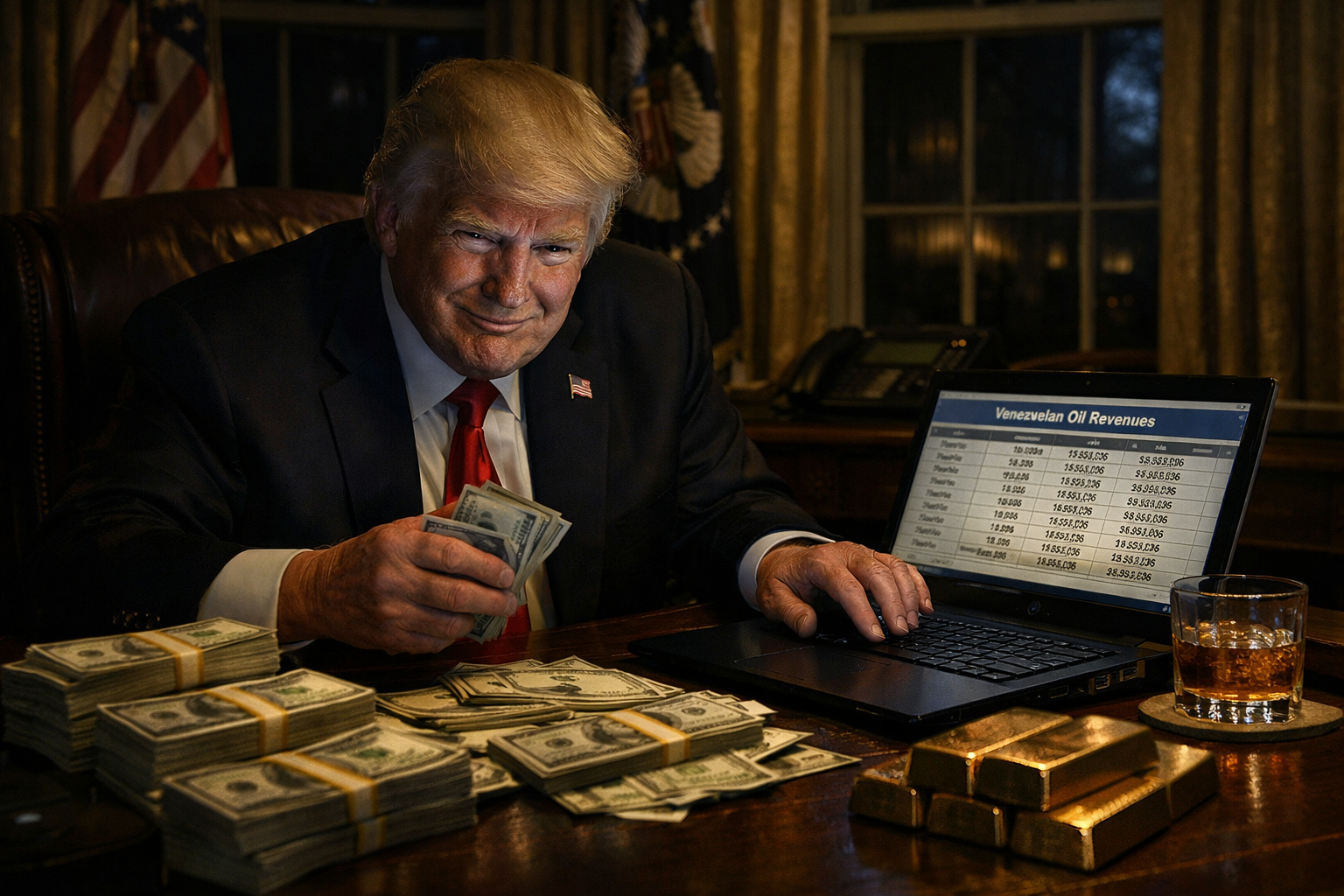
If you’ve been following my channel, “How Much Would I Have If…“, you know we usually talk about boring things like “What if I bought Nvidia in 2010?” or “What if I actually saved my Starbucks money?”
Today, we’re getting spicy. We’re looking at geopolitical arbitrage — How much is Venezuelan oil worth?
Specifically: How much would you actually have if you managed to liquidate the Venezuelan oil “seized” or blocked during the Trump-era sanctions and parked that cash in a tax haven?
Grab your offshore banking forms—it’s time for some high-stakes math.
The asset: 10 million barrels of “sanctioned” crude. How much is Venezuelan oil worth?
One of the pressing questions in today’s market is: how much is Venezuelan oil worth? This question drives much of the discourse surrounding oil prices and geopolitical strategy.

It’s crucial to address the question of how much is Venezuelan oil worth, especially when discussing the broader implications on global oil markets.
To understand the value, we have to look at the Trump administration’s “Maximum Pressure” campaign. Between 2019 and 2020, US sanctions effectively turned Venezuelan oil into “ghost cargo.” Tankers were stuck at sea, and PDVSA (the state oil company) was desperate.
If you were a “creative entrepreneur” who managed to “liberate” a fleet of these tankers, here is the breakdown of your inventory:
When evaluating potential profits, it’s vital to consider how much is Venezuelan oil worth in today’s changing landscape.
- Type: Merey 16 (Extra-heavy crude).
- Volume: 10,000,000 Barrels.
- The “Shady Dealer” Discount: Because this oil is sanctioned, you can’t sell it at the Brent Crude market price. You’re selling it on the “grey market” to refineries in Asia that don’t mind the paperwork headache.
The sale price: navigating the grey market — How much is Venezuelan oil worth?
In a world where standard oil trades at $75/barrel, sanctioned Venezuelan heavy crude often sells at a $30–$40 discount.
Now, let’s dive deeper into how much is Venezuelan oil worth in comparison to other crude oil types.
To conclude, the question remains: how much is Venezuelan oil worth? It’s a significant consideration for investors and policymakers alike.
The Math: 10,000,000 Barrels x $35.00 (Black Market Price) = $350,000,000 Gross Profit.Ultimately, understanding how much is Venezuelan oil worth requires analyzing both market dynamics and the impact of sanctions.
The strategy: The offshore compounder
You can’t just walk into a local credit union with $350 million from a sanctioned oil regime. To keep this money, you need an offshore financial center (OFC)—think the Cayman Islands, Panama, or Bermuda.
While the internet thinks offshore accounts pay 20% interest, the reality is more about capital preservation. However, if you invested that $350M into a diversified, tax-neutral portfolio, a 4% annual return is a realistic “safe” benchmark.
Five years of compounding (2021–2026)
In retrospect, understanding how much is Venezuelan oil worth sheds light on the complexities of the oil market.
As we assess the financial implications, one must ask how much is Venezuelan oil worth in the long-term economic outlook.
Finally, let’s wrap up our analysis by reflecting on how much is Venezuelan oil worth, and what it means for the future.
Here is how that $350 million grows when the IRS isn’t invited to the party:
| Year | Starting balance | 4% Annual interest | Ending balance |
| Year 1 | $350,000,000 | $14,000,000 | $364,000,000 |
| Year 2 | $364,000,000 | $14,560,000 | $378,560,000 |
| Year 3 | $378,560,000 | $15,142,400 | $393,702,400 |
| Year 4 | $393,702,400 | $15,748,096 | $409,450,496 |
| Year 5 | $409,450,496 | $16,378,019 | $425,828,515 |
The final tally: Why geopolitics pays better than your 401k
If you played the Venezuelan oil crisis perfectly and sat on the cash for five years, you would be sitting on $425,828,515.
To put that in perspective:
- You earned $75.8 million just in interest.
- That’s roughly $15.1 million per year in passive income.
- Your daily “allowance” from interest alone would be $41,549.
The catch (the intellectual honesty part)
While the math looks great on paper, the “how much would I have” factor usually hits a wall called the Department of Justice. Moving sanctioned oil is a one-way ticket to a permanent vacation in a federal facility.
Understanding how much is Venezuelan oil worth is essential for anyone engaged in the oil and gas sector.
But as a hypothetical? It’s the ultimate lesson in how distressed assets and tax-free compounding are the two greatest levers of the ultra-wealthy.
Data sources and intellectual honesty
To keep things grounded in reality, we used the following historical and market benchmarks:
- Oil Pricing: Historical Merey 16 discounts are based on S&P Global Commodity Insights data from the 2020-2022 period.
- Yields: The 4% ROI is based on standard “Private Banking” conservative portfolio yields in tax-neutral jurisdictions like the Cayman Islands.
- Legal Context: For more on how these sanctions work, you can read our deep dive on [how offshore banking actually works] (Internal Link) or the [OFAC Sanctions search] (External Link).
People also ask
What is the current discount on venezuelan crude?
As of 2026, Venezuelan oil (Merey 16) still trades at a significant discount to Brent and WTI, usually between $15 and $25, depending on the current level of US sanctions enforcement and global demand from “independent” refineries.
Can individuals legally buy seized assets?
Generally, no. Assets seized by the US government are typically auctioned off or managed by the Department of the Treasury. Buying sanctioned assets directly from a sanctioned entity (like PDVSA) can lead to massive fines and imprisonment.
How do offshore accounts protect wealth?
Offshore accounts in “tax-neutral” jurisdictions don’t necessarily provide high interest; they provide legal distance. By holding assets in a trust or shell company, owners can minimize tax exposure and protect assets from domestic litigation.